The Philosophy
What Is Human Rewilding?
“The agent-based activities pursued by some humans, past and present, to gain back capacities for food autonomy, gain back traditional skill sets required for meeting basic needs, and to reestablish traditional indigenous and hunter-gatherer inspired socioeconomic lifeways centered on relations of ecological wellbeing within bioregionally specific contexts.”
Human Rewilding is the conscious effort to reclaim the skills, knowledge, and social patterns that sustained our species for hundreds of thousands of years before the advent of division of labor-based complex societies. It is not nostalgia. It is not fantasy. It is a practice rooted in the anthropological and archaeological record of how humans most successfully adapted to life on Earth for the vast majority of our existence.
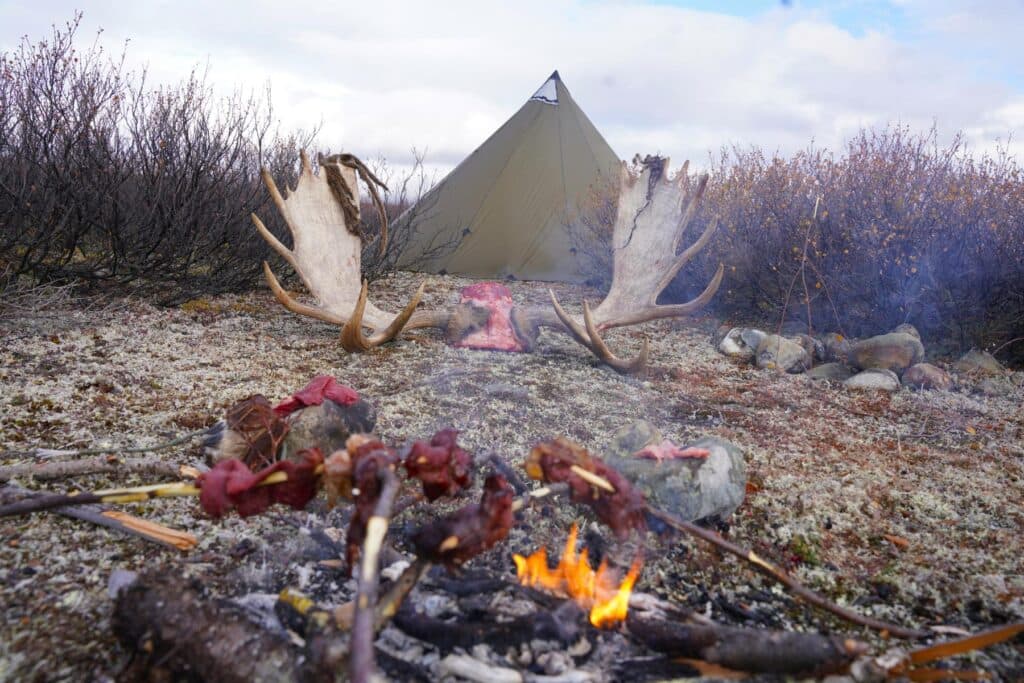
In practice, this means learning to obtain our basic physical needs — food, clothes, water, shelter — directly from the land — hunting, gathering, fishing, foraging and permaculture-type pursuits. It means understanding and practicing the material technologies that made this possible: animal and plant food processing and preservation, skin tanning and sewing, fiber arts, fire by friction and fire tending, building weaponry, traps, land travel, and flintknapping. And it means building social relationships modeled on the non-hierarchical, small-scale communities that are our evolutionary heritage.
Human Rewilding is not about individual lifestyle choices. It is a political and ecological stance that recognizes techno-industrial Modernity as fundamentally incompatible with long-term human and ecological wellbeing.
Core Principles
Food Autonomy Is the Foundation
The ability to directly obtain one's own food from the land is the material basis of genuine freedom. Without it, all political freedom is contingent on systems of production controlled by others.
Neither Left Nor Right
Both progressive and conservative political frameworks operate within the logic of unsustainable and ultimately harmful "progress" and techno-industrial Modernity. Human Rewilding rejects this shared baseline entirely.
Indigenous Hunter-Gatherer and Horticultural Lifeways as Evidence
The longest-enduring, most ecologically stable human societies were not states, not agricultural, and not resource-intensifying civilizations. This is not romanticism — it is the anthropological and archaeological record.
Egalitarianism Is Enforced, Not Natural
Human egalitarianism — non-hierarchy over one another and the Earth — is maintained by active cultural practices that suppress accumulation, resource intensification, and economic "growth." It is a political ethos which must be continuously defended through baseline eco-material practices, not ideology. This state of actualized human liberty is a political achievement that is first and foremost the legacy of band-level hunter-gatherers.
Skills Are Resistance
Reclaiming ancestral skills — hunting, foraging, land-based mobility, stone technology and primitive weaponry, and a band-level sociality — is not nostalgia. These are the material practices required for building independence from systems that are destroying the Earth.
Bioregional Specificity
Rewilding is not a universal prescription. It is rooted in specific landscapes, specific ecosystems, specific relationships between specific groups of humans and their local ecology.
Anti-Production, Anti-Growth
The problem is ultimately the logic of specialized production, accumulation, supply-chains, and market-oriented growth itself.
Civilization Is the Crisis
Civilization is a way of life based on mass resource extraction and growth. The ecological crisis is therefore not a bug of civilization — it is a primary feature. No reform of techno-industrial society addresses this root cause.

“This is a passionate manifesto in defense of rewilding against those who criticize it while promoting techno-industrial civilization. It is an invigorating and inspiring read.”
Read the Book
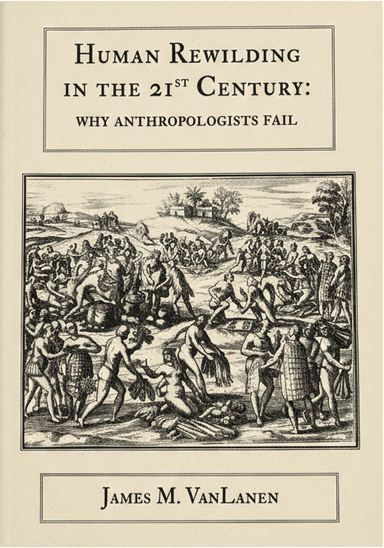
Human Rewilding in the 21st Century
Why Anthropologists Fail
2024 · Birch Top Hill Press
Drawing on anthropology, archaeology, and lived experience, this book lays out the case for abandoning the techno-industrial trajectory and reclaiming the indigenous ways of being which were the most socially and ecologically endurable — a practical and philosophical blueprint for human rewilding. The book is also an in-the-face response to rewilding's critics, particularly a certain cadre of anthropologists.
History of the Concept
The roots of Human Rewilding reach back to the earliest observations that pre-industrial peoples lived fundamentally different — and in many measurable ways, healthier and more egalitarian — lives than their resource-intensifying agricultural and industrial counterparts.
Indigenous inspiration comes from the thousands of Indigenous peoples in history and prehistory who have turned to “secondary primitivism,” as described by Pierre Clastres and James C. Scott, as viable methodology to escape from tyrannical, ecologically destructive, resource-intensifying societies.
Western philosophical precursors include the work of James C Scott, John Zerzan, Fredy Perlman, Stanley Diamond, and Jacques Camatte, who articulated critiques of civilization from anarchist and anthropological perspectives. The ethnographic record compiled by researchers like James Woodburn, Jerome Lewis, Camilla Power, Peter Gardner, Richard Lee, Colin Turnbull, Bernard Sellatto, and Frank Marlowe provided the empirical foundation.
The term “Human Rewilding” as a specific concept and practice was formulated by James M. Van Lanen, drawing on his fieldwork with indigenous hunter-gatherers on three continents and his background in anthropology. It sits within the broader anti-civilization and anarcho-primitivist tradition while being distinguished by its emphasis on ethnographic evidence, material practice, and bioregional specificity.
How Human Rewilding Differs From…
Often confused with:
Conservation rewilding (reintroducing wolves, bison)
Human Rewilding is about HUMAN lifeways, not wildlife management.
Often confused with:
Survivalism / Prepping
Human Rewilding rejects the individualist, fear-based framing. It’s about community and deep time, not apocalypse prep.
Often confused with:
Paleo lifestyle / "Ancestral health"
Human Rewilding goes beyond diet and exercise to critique the entire structure of civilization.
Often confused with:
Primitivism (as caricatured)
Human Rewilding is grounded in ethnographic evidence and ongoing indigenous practice, not utopian fantasy.
Often confused with:
Back-to-the-land homesteading
Homesteading typically operates within agricultural and property paradigms that Human Rewilding critiques.
Often confused with:
Environmentalism / Green politics
Mainstream environmentalism fails because it doesn’t challenge "progress" itself.